
Neighbors are convinced the famous Los Angeles home is falling apart. The owners don’t seem to know what they’re talking about.
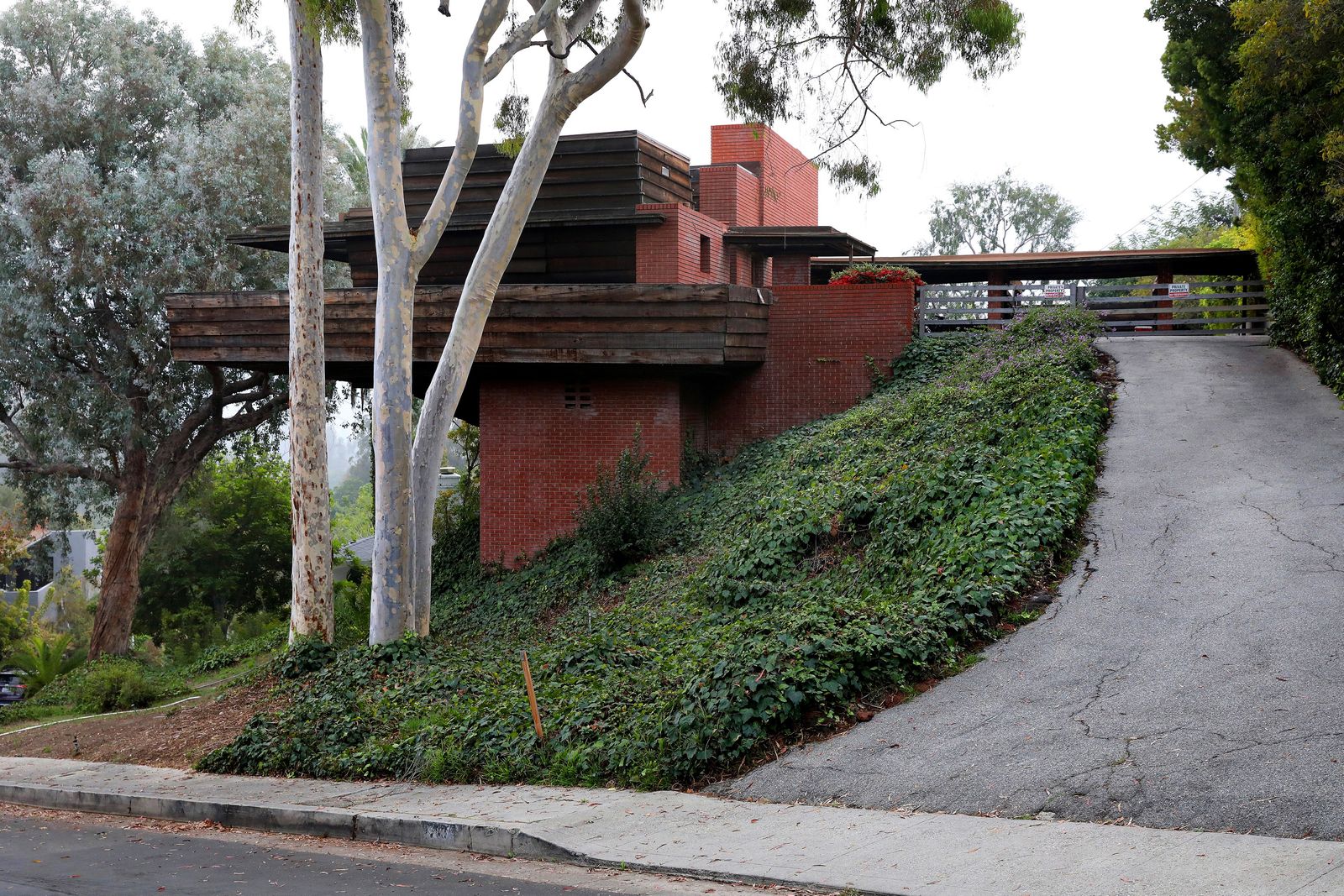
Roughly a dozen years ago, if you walked up the steep incline of North Skyewiay Road in the upscale Brentwood Heights neighborhood of West Los Angeles, you might have seen Jack Larson’s dog sprawled on the deck of the actor’s brick-and-wood home soaring over a steep embankment. The richly-colored redwood structure leaned over a hilly yard ringed in ivy, and Dewey, a white shepherd, loved to lounge in the sunshine on what resembled the prow of a ship.
While the home, the Frank Lloyd Wright-designed Sturges House, was always considered a source of neighborhood pride, today, its condition and future are being called into question. Many neighbors have worried in recent years that it’s entered a state of disrepair, and some have even said they’ve seen coyotes on the grounds, though those claims have not been independently verified.
The Los Angeles Conservancy placed the home on its 2026 watchlist for endangered buildings and starting in late August, a series of stories about the state of the home, especially an Artnet piece, explained how the home, an official Historical-Cultural Monument (HCM), was at risk of what’s called "demolition by neglect." The Artnet piece and a number of additional stories raised the tenor of concern about the architectural marvel, one of eight in Wright’s exceptional Greater L.A. body of work, including the Hollyhock House, a UNESCO World Heritage Site.
But the current owners of the home vehemently deny that the home is in some state of decay or poor maintenance. The property was purchased during an auction in 2016 by the All Right Now Foundation, a nonprofit set up by a group interested in preserving the home that includes Robert Brisco, CEO of online publisher Internet Brands. Foundation lawyer Wendy Giberti says the claims made by neighbors are all categorically untrue and defamatory. Why would a foundation spend millions of dollars to buy and maintain a property if they didn’t want to take care of it? "I can tell you there has been a considerable investment in the property," says Giberti. "The idea that we are being neglectful is a little bit insulting."
When I walked on the sidewalks on the perimeter of the property on September 29, it was ringed with a number of signs declaring the site private and the cantilevered, wooden portion of the residence showed its age. The wood looked weathered, and in a handful of spots, small gaps were visible between the planks.
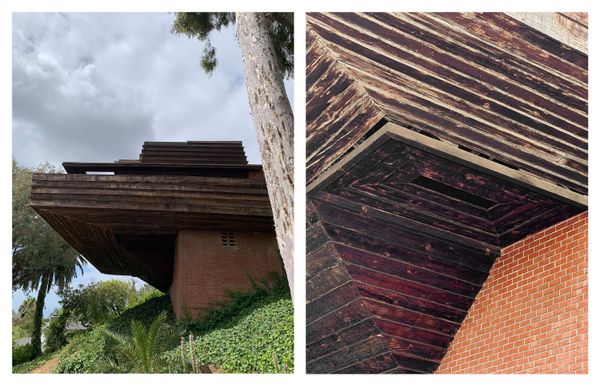
Neighbors of the Frank Lloyd Wright’s Sturges House in Los Angeles say that the home is falling into disrepair. Photos from this year show a piece of the decking coming apart.
Photo by Daniela Velazco/L.A. Conservancy (left); photo courtesy Patrick Sisson (right)
When asked about the foundation’s investments, Giberti pointed to regular gardening and repair, an on-site caretaker, and "large expenditures, including planning for what is to come next and making sure the building stays safe until such time as a larger project is going to be undertaken." A statement from the foundation on September 2 also mentions "regular maintenance, upkeep, and inspections by licensed experts, including structural engineers, waterproofers, electricians, and plumbers."
This situation—preservationists and neighbors raising concerns that private owners of a historic property aren’t living up to their public duty, and the owners pointing out that they’re following the law and it’s nobody else’s business—isn’t unique. Preservationists have criticized Los Angeles’s preservation laws for lacking teeth and clear enforcement powers. As Barbara Gordon, executive director of the Frank Lloyd Wright Building Conservancy, sees it, preservationists feel their hands are tied if ownership doesn’t meet the public’s expectations for conservation. "How do you enforce preservation rules moving forward if all the owners are getting small fines?" says Gordon. "How do you enforce it at a larger scale? Because I think it's not just this building. This is one of many."
Other such examples of landmark homes suffering from what preservationists have deemed insufficiently dedicated owners include the Walser House in Chicago, another Wright design, which entered a period of disrepair after the owner passed away, and the Wattles Mansion in Los Angeles, a Hollywood mansion that was at one point falling apart due to disrepair and poor city ownership. "It’s more common than not in L.A. because the consequences are just not stringent, unfortunately," says Jaime Rummerfield, an interior designer and cofounder of the preservation nonprofit Save Iconic Architecture. "People get a slap on the wrist."
All Right Now Foundation purchased the Sturges House in 2016 for approximately $1.85 million. The foundation, based in nearby El Segundo, California, won an auction held after Larson’s death in 2015; Larson and director James Bridges bought the house in 1967 from the original owners, Lockheed engineer George Sturges and his wife, Selma, who had commissioned Wright to design a home for them in 1938. Designed by Wright with construction supervised by architect John Lautner, the Sturges House was built around the same time as Fallingwater, and is recognized as a striking example of cantilevered architecture and Wright’s Usonian residential style.
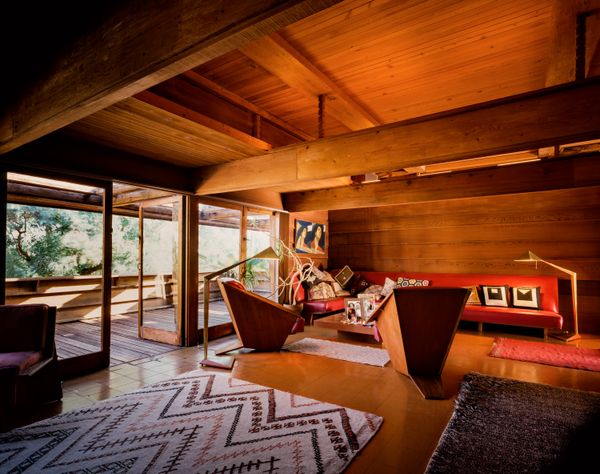
The home sits in the Brentwood Heights neighborhood and was built in 1939.
Photo © Michael Freeman
The foundation, according to Giberti, remains committed to maintaining the home, who adds that it will always, primarily, be a residence. "It’s not going to be a museum or open to the public or any of those other things," she says. The website maintained by the foundation has a Tours section, but it remains blank except for a single photo (it also recently posted a number of interior photos marked fall 2026). Architect Joshua Moratto, who was listed as a member of the foundation’s board in its 2024 tax return, declined to comment on the story. (On his Instagram, there are a pair of posts from last year partially captioned with "an addition to an Usonian").
The foundation has yet to announce its plans, despite more than a decade of ownership, and in the same September 2 statement the foundation sent to media, noted that the board, which "consists of private citizens who prefer to focus their resources quietly on the work of preservation rather than engaging in public debate," were still coming up with a long-term plan for the property. The statement went on to say the issues with the wooden exterior were "cosmetic," and that the "functional condition has improved from when it was acquired."
So far, according to Gordon, the foundation hasn’t reached out to the Frank Lloyd Wright Building Conservancy. That’s odd, says Gordon; the community tends to be tight-knit, and the nonprofit can offer extensive resources around the restoration and maintenance challenges of Wright’s work.
Giberti argues that it’s simply nobody else’s business but ownership. "It has been our experience that when they are left in the dark or feel they’re not getting information that they think they’re entitled to, they resort to other means," she says, in reference to what she calls disgruntled neighbors who have complained about the foundation’s work. "I can’t control their desire to be involved, or their desire to control, especially the timeline. But they have made it clear they intend to continue attempting to insert themselves into the process, and I will continue to insist they shall not be inserted into the process."
According to the Los Angeles Department of Building and Safety (LADBS), the home was issued what’s called an "order to comply" on August 24, which directed the owners of the building to repair and maintain the existing wood balcony and the existing historical building. A LADBS spokesperson said "the related portions of the building have been deemed unsafe." The property is still listed as "under investigation" on the department’s website and the spokesperson reiterated on October 5 that the issue hasn’t been resolved.
Giberti says the foundation paid the requisite $300 fine, that the basis for that complaint was a "drive-by by an inspector," and that they obtained a structural engineering report saying it wasn’t unsafe, and was "probably more safe than what current code is for new homes." She said the deck is structurally sound, the report that says so was provided to a city inspector, and assumes the issue is resolved. (Numerous attempts to contact the city inspector listed on the LADBS site have been unsuccessful).
Some neighbors have repeatedly complained about the state of the house, arguing that what they call disrepair and desertion is a safety issue. Nearby resident Lisa Chadwick, who reached out to Gordon, sent images to local media, and has brought up the building’s conditions to the city and L.A. councilmember Traci Park, believes that more pressure is the only thing that will get the owner to do something. "I think the more attention it gets, the more pressure he’s going to have, either to sell it or to do something," Chadwick says.
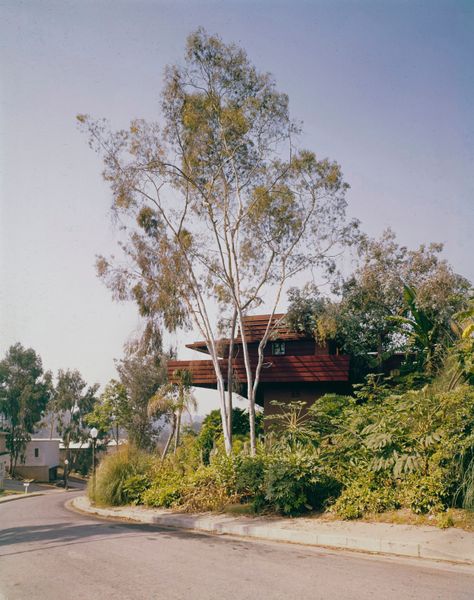
The residence, pictured here in 1962, is an example of Wright’s Usonian style homes.
Photo by Julius Shulman, © J. Paul Getty Trust. Getty Research Institute, Los Angeles (2004.R.10)
See the full story on Dwell.com: What in the Name of Preservation Is Happening With Frank Lloyd Wright’s Sturges House?
Related stories:

No comments:
Post a Comment