
The first episode of his "Minecraft" YouTube series, which has gone viral, reveals some surprisingly considered interior design decisions.

The private lives of professional football players have long been their own spectator sport. Their faces populate advertisements, their relationships make headlines, and their extracurricular pursuits attract nearly as much attention as their performances on the field. But what about their coaches? Unless you’re former Patriots honcho Bill Belichick, it’s rare you get a spotlight off the field.
But in September, former Pittsburgh Steelers coach Mike Tomlin became another unlikely exception. He released the first episode of his own YouTube series, giving the world wide web a tour of an elaborate city he’s spent the last 12 years building—in Minecraft. Naturally, the internet exploded. The popular video game, which launched in 2009 and lets players build open-ended worlds, commented under a video on its own YouTube channel, "i'm honored to be here coach [two-hands-raised emoji]". Barstool Sports joked on X, "Imagine drinking beers with the fellas in the Mike Tomlin Minecraft speakeasy." Former Steelers running back Le’Veon Bell was less impressed, posting, "we were tryna win super bowls and coach T was on minecraft building cities [loudly-crying-face emoji]."
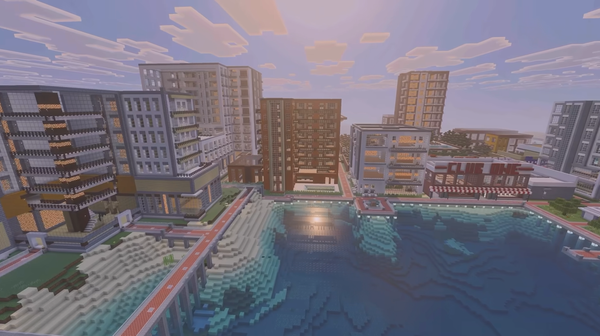
Former Pittsburgh Steelers coach Mike Tomlin has spent hours building cities in Minecraft. This one started around a body of water.
Screenshot: Mike Tomlin/YouTube
Tomlin spent 19 seasons at the helm of the Steelers, winning a Super Bowl and never recording a losing season, before stepping down in January of this year. For much of his professional life, he was an authority in one of the most scrutinized jobs in professional sports. But in Minecraft, which he started playing as a proverbial rookie more than a decade ago, he’s been able to quietly hone is craft, mining iron ore, evading exploding monsters (a.k.a creepers), and, yes, designing buildings.
When his kids were in middle school they were obsessed with the game. First released in 2009, players Tomlin says he began by watching them play, fascinated by what could hold their attention for such long stretches of time. He eventually picked up a PlayStation controller and started a city of his own. At some point, his kids lost interest. He did not. "I started small and, of course, over the course of 12 years, you develop neighborhoods and communities," he says in the video.
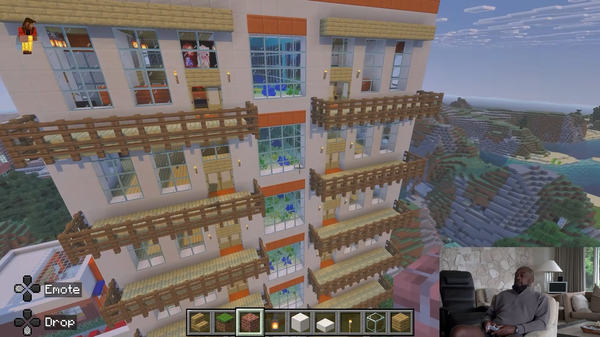
Tomlin designed an apartment building that features an aquarium on every level.
Screenshot: Mike Tomlin/YouTube
In the nearly 20-minute first installment, ROOFTOPS, PENTHOUSES, AND URBAN LIVING [sic], Tomlin starts with the first building he ever built: a "boutique hotel" on a bay. Just off the lobby is the "executive spa"; across the way, a multipurpose space doubles as both a conference room and ballroom. And then there’s the basement: a stone-walled speakeasy whose pièce de résistance is a window looking into the swimming pool.
For all the fantasy Minecraft affords, Tomlin is equally attentive to the less glamorous side of running a hotel. The speakeasy has a kitchen and employee work area; elsewhere, men’s and women’s restrooms are complete with sinks and stalls, even if the game requires none of it. Unlike The Sims, Minecraft isn’t built around the logistics of human habitation. In Survival Mode—where players must source food and fend off zombies—nobody needs a toilet. And he doesn’t belabor the point: his bathrooms are relatively spare, not an excuse for some aesthetics-driven folly. "I was always really conscious of appropriate amenities," he says.
But Tomlin’s concern for realism goes beyond imposing real-world requirements on imaginary buildings. Some design problems, like lighting, are actually real within the game. "I was really lighting conscious," he says, explaining that when he started the city, illuminating interiors was a challenge. He added the glass ceiling in the hotel’s conference room mainly to let in light and "less for the architectural component of it." Down in the windowless speakeasy, he used Glowstone—Minecraft’s conspicuous, light-emitting block—not because he likes the look (he doesn’t), but because lighting, to him, is just that important.
Tomlin’s vision doesn’t begin and end with a collection of show-stopping structures with empty interiors, as many often do. From the get-go, he had a larger plan: a densely populated urban center, with high-rises clustered around bodies of water. (It’s unclear in the video if his city includes a football stadium, though there is an "MLS soccer stadium" and a baseball field.) Sometimes that required reshaping Minecraft’s randomly generated terrain. "I’d have to blow up mountains and hills and so forth and redevelop land around it," he says. "I would work areas around bodies of water and then over time the areas grew together." It’s actually a natural approach to urban planning; waterways, after all, have been shaping cities since ancient Mesopotamia and Egypt.
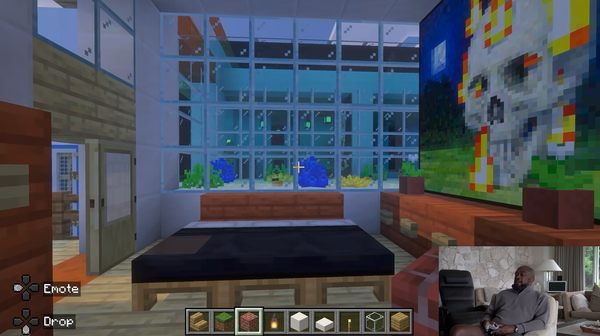
Tomlin walks us through his design decisions for one of the aquarium apartments.
Screenshot: Mike Tomlin/YouTube
See the full story on Dwell.com: Former NFL Coach Mike Tomlin Is a Total Lighting Snob
Related stories:

No comments:
Post a Comment