
Why we're using a shared nostalgia for the corded phone to free us from our screen-time obsessions.

About a year ago, Lauren Czajka stopped carrying her phone with her from room to room. A nonprofit executive working in the teen mental health space, she was acutely aware of the problems that smartphones cause—depression, sleep loss, lower cognitive performance. But while reading the book Stolen Focus, she learned just how much our attention spans are diminished by our devices and decided to change her relationship with her digital appendage. There was one problem, though: Her young kids would find her phone wherever she left it and would bring it back to her. They were trying to be helpful. "It breaks my heart that they see it as a problem when I don't have my phone," she says.
Czajka’s longtime friend Kate Trey came up with an idea: a coiled phone charger that’s an homage to the kitchen landline she grew up with that would require walking to a set location in your home to use your phone. Czajka made a model out of a pizza box for a wall mount that would attach her phone to a charger using a long, loopy wire; several prototypes later, the cardboard prototype became Coilie, a silicone-coated aluminum perch for your smartphone that turns it into a "landline" by tethering it to the wall. It’ll formally launch on Kickstarter later this summer in a variety of bright, throwback colors.
Czajka and Trey are part of a growing movement of "landlining" smartphones to curb our addictions to devices while at home. Partially driven by a nostalgia for the corded phone, the idea to dock your smartphone has been making the rounds on social media, solidifying the trend of turning one’s everywhere-all-the-time phone into an old-school landline. On Instagram, Laura Ambrosia, who runs a wellness retreat in Sacramento, posted a video of her "landline" system that’s meant to set a better example of boundaries for her children; Tiffany Ng, author of the blog Cyber Celibate, posted a video of homemade landline experiments, using pearl strings and climbing rope to hang a cellphone from a wall peg. (Each received more than 32,000 likes and 10,000 likes, respectively.)
Coilie’s founders note that when they began sharing their product’s website they hoped to get 1,000 pre-orders in the first month. They quickly surpassed 4,000. "People want this product, they want to buy it, they want to be able to hang up their phones," Trey says. Oddly, tethering our phones reflects an expanding desire for freedom from them; of course, a slew of new apps that turn your phone into a "dumb" device, blocking social media but allowing calls and texts, is another option.
For interior designer Ryan Shand, unplugging from your device is as much a design problem as it is one of self-control. "I believe that our homes pave the way for our nervous systems, and how we’re able to show up in a space and our environment can alter the way that we feel," she explains. Shand, who co-owns Shand Design with her mom in Santa Barbara, recently shared her personal home phone solution on Instagram: Instead of opting for a wall-mounted charger, she stores her cell in a 1920s brass wall planter when she gets home from work. Having a specific place that the phone lives creates what she calls a "landing zone"—a design principle with a calming effect that she encourages for her clients’ homes, too.
Shand recommends spaces near an entryway or in a common area, places where we might store keys or wallets. Placing your phone in its "home" or perch transforms it from a mobile device to a landline and stops that panicked feeling of "where’s my phone" when it’s not immediately in reach. "People then have a connection to where something might be, especially because we are designing quite large homes," she says. If your home is your sanctuary, can you really relax after a long day when your obligations are immediately accessible? Shand doubts it. The landing zone instead affirms the home’s purpose as a haven, putting hard boundaries around what is required to actually unwind.
Both Shand and Coilie’s founders are parents to young kids and mentioned the struggle to model better behaviors toward technology; such skills aren’t easily communicated to children who grow up watching their parents scroll, text, and check emails all day. "We were not the generation that made smartphones and got us all addicted, but it’s up to our generation to solve that problem and establish what is appropriate behavior for smartphone usage," says Trey. Some parents are opting to literally bring back the old apparatus: Artist Andy Bellomo has thought about getting a landline after years of being "swallowed" by her cell. With a four-year old daughter who was rapidly making new friends, Bellomo purchased a Tin Can—a screenless, internet-enabled device that allows kids to call other Tin Can phones for free.
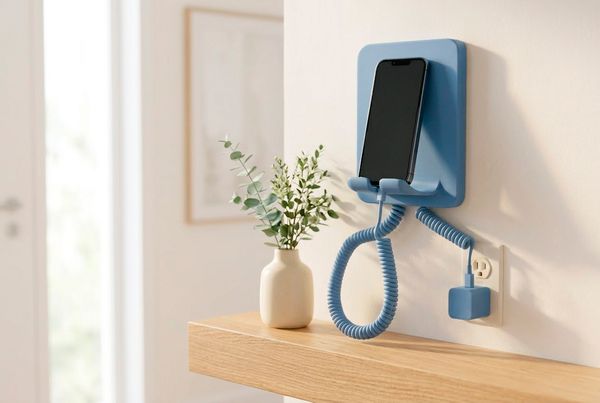
Lauren Czajka and Kate Trey developed a smartphone dock called Coilie to create boundaries around screen time at home.
Rendering courtesy of Collie
When Bellomo’s family got the Tin Can, she and her partner realized they had to train their daughter in phone etiquette—though many parents of young kids might have grown up watching their parents answer the phone and hold long conversations with friends and family, these practices aren’t always modeled for today’s kids. "We taught her how to say hello, how was your day, and what are you doing; now she practices that and the conversations are interesting," says Bellomo. She adds that her daughter has learned how to listen to others and to wait for pauses in the voice on the other end before adding to the conversation—a type of mindfulness that requires attention to others’ verbal cues without seeing faces. Her daughter also learned that conflicts can be resolved over the phone.
It’s extra parenting, for sure, but Shand says that the mythology of design is that it is always used to make something difficult easier—but that is precisely what got us hooked on smartphones in the first place. Landlining our phones might add a little friction to the now-seamless act of picking up a call or responding to a text. But that friction could make our lives infinitely better.
Top photo by Harold M. Lambert / Getty Images
—
Related Reading:
30 Low-Tech Accoutrements for a Screen-Free Summer—Including Outdoor Furniture, Lighting, and More

No comments:
Post a Comment