
On a trip to Roswell, a city known for UFOs and military secrets, my girlfriend and I stayed in an appropriately off-center spot: a former missile base made into a subterranean rental.

Welcome to One Night In, a series about staying in the most unparalleled places available to rest your head.
During the Cold War, when humanity seemed hellbent on annihilation, underground Atlas missile bases made of steel and concrete were built across the United States to ward off World War III.
Newer missile technology quickly replaced those Atlas bases, and the sites were all decommissioned and closed by the mid-1960s. Today, though, you can sleep in one below the plains of southeastern New Mexico, if you’re not claustrophobic. Gary "Siloman" Baker bought the decommissioned complex in Roswell—minus the missile—30 years ago and transformed its launch center into an overnight stay that he operates as an Airbnb.
Baker is one of a number of people around the country and as far away as Cornwall, England, and Australia who have turned subterranean bunkers into short–term rentals and even residences. In Arkansas, the Titan II Nuclear Missile Complex prioritizes the party over missile history; the former missile complex made into an underground rental includes a small nightclub. (Owner GT Hill says he’s hosted families from Taiwan, a slew of social media influencers including YouTube celebrity Mr. Beast, and, possibly, a swingers group.) A decommissioned Atlas base in Kansas has "survival condos" where owners, and pets of a certain size, can ride out apocalyptic events for up to five years for $1.3 million (there’s also an Atlas missile base Airbnb listing in Kansas), and a Texas company called Atlas Survival Shelters offers everything from bomb and tornado shelters to "billionaire bunkers" that, according to its website, can house up to 15 people in the event of "pandemic outbreak, civil unrest, malicious mobs," and other events.
Baker’s place in Roswell—listed as one of Airbnb’s top-rated OMG! homes—seemed like it’d actually be a pretty ideal overnight stay while my girlfriend, Jen, and I explored the alien kitsch of the desert city, where a UFO may or may not have been discovered in 1947. The decommissioned base sits just 20 miles from the area’s UFO-shaped McDonald’s and the giant alien outside the Dunkin’ Donuts downtown. And staying there—on Jen’s birthday—would be fittingly "out there."
Gary "Siloman" Baker turned the decommissioned Atlas missile base in Roswell, New Mexico, into an Airbnb that’s one of the platform’s top-rated OMG! vacation rentals. The silo extends 180 feet underground.
Photo: Jason Nark
"The land beneath it is silent—but listening," read a confounding review by a former guest from Sedona that Jen found on the Airbnb listing. "The container was never meant for humans. And yet, we entered anyway."
Jen and I have slept in some fancy New York hotels, and we’d recently spent a week in dreamy beachfront casitas in Oaxaca. I’ve also spent a lot of nights sleeping in tents, the bed of my truck, or in glorified sheds for reporting trips, and Jen had slept in an underground structure before. The silo felt somewhere down the middle. She was intrigued, so I reached out to Baker about his silo, and he offered us a media discount to stay there in early April.
"When do we leave?" Jen said.
Saturday
3 p.m.: An underground missile complex doesn’t stand out in the landscape, so we have to pay attention to the mile markers as we drive through sagebrush and yucca outside of Roswell. We flew from Philly to El Paso yesterday, and slept hard at a classic motor inn about 90 minutes away in Alamogordo. In the morning, we walked in the dunes at White Sands National Park for Jen’s birthday. Roswell is about a 120-mile drive from here.
Baker’s directions take you to a cattle gate and up a dirt road to a small, fenced-in area with a large concrete and steel pad. It looks like a public works yard in Anytown, USA. During the Cold War, though, that concrete pad could have opened up like some hellmouth, and an 82-foot missile could have rocketed toward Moscow to wreak havoc.
An employee of Baker’s named Manny meets us topside and leads us to a single, nondescript bulkhead door to the silo’s stairwell. Inside, it’s crammed with black-and-white Atlas photos from the 1960s down every step. That history-heavy theme plays everywhere down there, even into the bathrooms.
The guest apartment, which according to the Airbnb listing has "about 1,250 square feet of space," is in the upper level of the former launch control center. The complex also includes a part-time apartment for Baker.
Photo: Jason Nark
Manny takes us to the apartment where Baker spends time when he’s not traveling with his wife. Baker, who was born in Alaska, is a warm and talkative historian who can wax about missiles and the Cold War for hours. He says he fell in love with missile silos when he attended Roswell’s New Mexico Military Institute decades ago. During the Cold War, more than 100 Atlas sites were built across the U.S. before they were decommissioned. Decades later, the Atlas sites that were left behind in Roswell became playgrounds for him.
"I bought two together thirty years ago for $55,000 a site," Baker tells us in his apartment, which sits below the guest quarters. "For me, this was just fun, something I always wanted to do."
Since then, he’s invested about $500,000 to make this place habitable for guests—it’s spotless and as well-lit as a big hole in the ground can be—and he charges close to $850 a night for overnight stays. He also hosts private tours between checkout and check-in. "If you’re looking just for a night’s stay, this is not it," he says.
5 p.m.: Manny takes us to the Airbnb unit, a former launch control room that sits beyond massive blast doors above Baker’s apartment. The launch controls are gone and the simple guest unit is circular, like Baker’s unit, with a laundry room, bathroom, and kitchenette that was, oddly, stocked with lots of food. The lighting isn’t great, but it’s not dark. There’s a couch and small table to eat meals, and more missile memorabilia, including magazines, coffee mugs, miniatures, pillows, and hard hats. A New Mexico vanity license plate affixed to the wall catches my eye; it says "Siloman."
The small bedroom, for some reason, has two twin beds (air mattresses are available for additional guests). "I guess we’re cuddling," I say to Jen.
This isn’t my first experience writing about underground living. In 2006, I visited a home/office built in New Jersey by Malcolm Wells, the late architect who pioneered underground buildings. I’ve also written about earthships, which are often quasi-underground. In 2024, I also profiled Rod Rylander and the off-grid, affordable home he was building halfway in the ground in southwestern New Mexico for Dwell.
Jen, as I mentioned, has actually slept beneath the earth though. During an Australian road trip, she stayed in a subsurface motel in Coober Pedy, a mining town where half the population lives underground because of extreme heat and flies. She visited a church there, shopped for opals, and had drinks with Greek miners, all underground. (There are plenty of "cave" and "earthen" Airbnb listings in Coober Pedy, too.) "The town resembles the surface of the moon and is just as quiet," she tells me on the drive to Roswell.
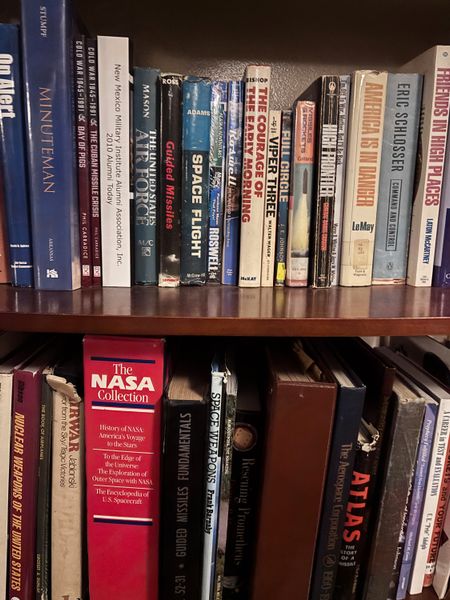
The guest unit is decorated with on-theme books, photos, drawings, and memorabilia.
Photo: Jason Nark
See the full story on Dwell.com: One Night in a Cold War-Era Bunker Turned Airbnb in New Mexico

No comments:
Post a Comment