
Eighty exhibitions provided more than enough space for makers to reinterpret the country’s craft traditions—or offer a new vision entirely.
When I walked into Lisbon’s Palacete Gomes Freire—a 19th-century palace painted a pastel but punchy shade of yellow—the first thing that my eyes fell on were five wall sculptures made of what appeared to be straw. They hung above the landing of a grand split staircase, an organic, earthy rebuttal to a space that represented the architectural opulence of another era. I’d soon learn that these sculptures are made of bulrush, a tall grass that’s native to Portugal. A chair sitting to the left of the sculptures features a back made of the same material, spun into a nautilus-like swirl, but paired with a clean-lined galvanized iron frame and seat. Though the wall sculptures first attracted my attention, the Cadeira chair is where my eyes rested, called to the pairing of these contrasting materials.
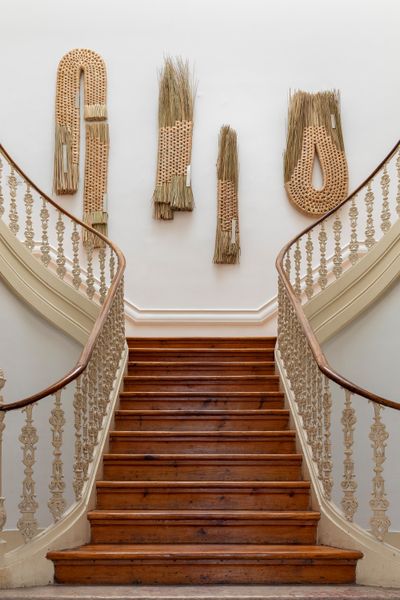
The bunho technique used for Macheia’s Bulrush collection is a traditional Portuguese basketry method that only two artisans in Europe still practice, per the design studio.
Photo courtesy Lisbon by Design
The pieces are by Macheia, a studio led by Lucrezia Papillo and Iany Gayo, who are following in the craft traditions of the country they both now call home, but with a contemporary lens. (Papillo is Italian-German, and Gayo is from Mozambique, but is part Portuguese.) The designers worked with local artisans Manuel Ferreira and Paulo Sousa on the sculptures and Cadeira chair, specifically using the Portuguese bunho technique that’s historically been used for basketry. With these pieces they want to bring the technique to a new context and audience without watering down the organic beauty that’s inherent to the traditional craft.
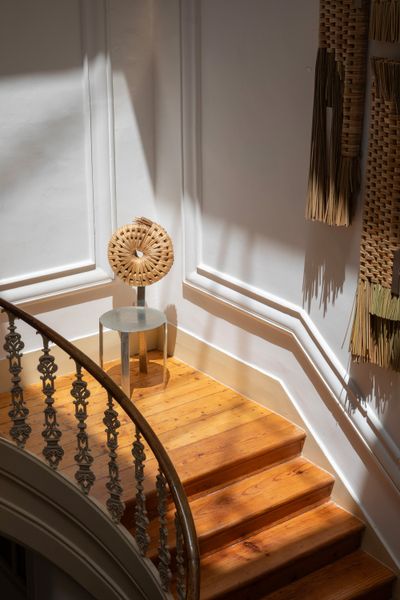
For the Cadeira chair, Macheia founders Papillo and Gayo collaborated with a blacksmith and a bunho artisan.
Photo courtesy Lisbon by Design
The chair and sculptures are just one example of the direction the country’s design scene seems to be headed in. While its identity has long been wrapped up in centuries-old craft traditions like tilework and embroidery, at Lisbon By Design, or Lisbon Design Week, which runs concurrently with a total of 80 exhibitions featuring work by over 150 makers across 11 neighborhoods, it seemed that the country’s designers—whether native-born or immigrant—were grappling with how exactly to create a new era for the Portugal design scene without abandoning the country’s rich design history.
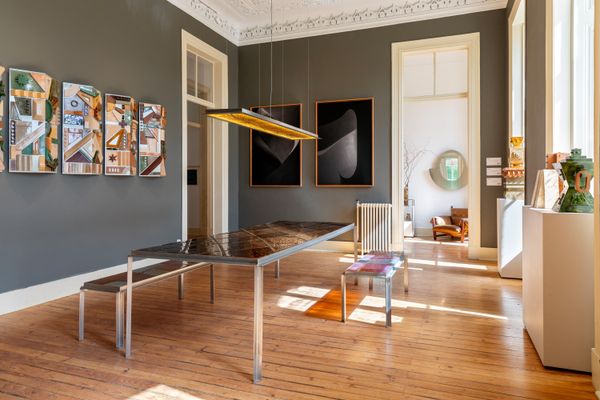
The work of Grau Ceramica was displayed alongside furniture by Martinho Pita Studio on the upper floor of the palace.
Photo courtesy Lisbon by Design
See the full story on Dwell.com: At Lisbon Design Week, Designers From All Over Grappled With Portuguese Design’s Identity
Related stories:

No comments:
Post a Comment