
At first he wasn’t sure how to update the ’80s residence by famed midcentury architect Walter S. White. Now he’s dedicated to its constant evolution.
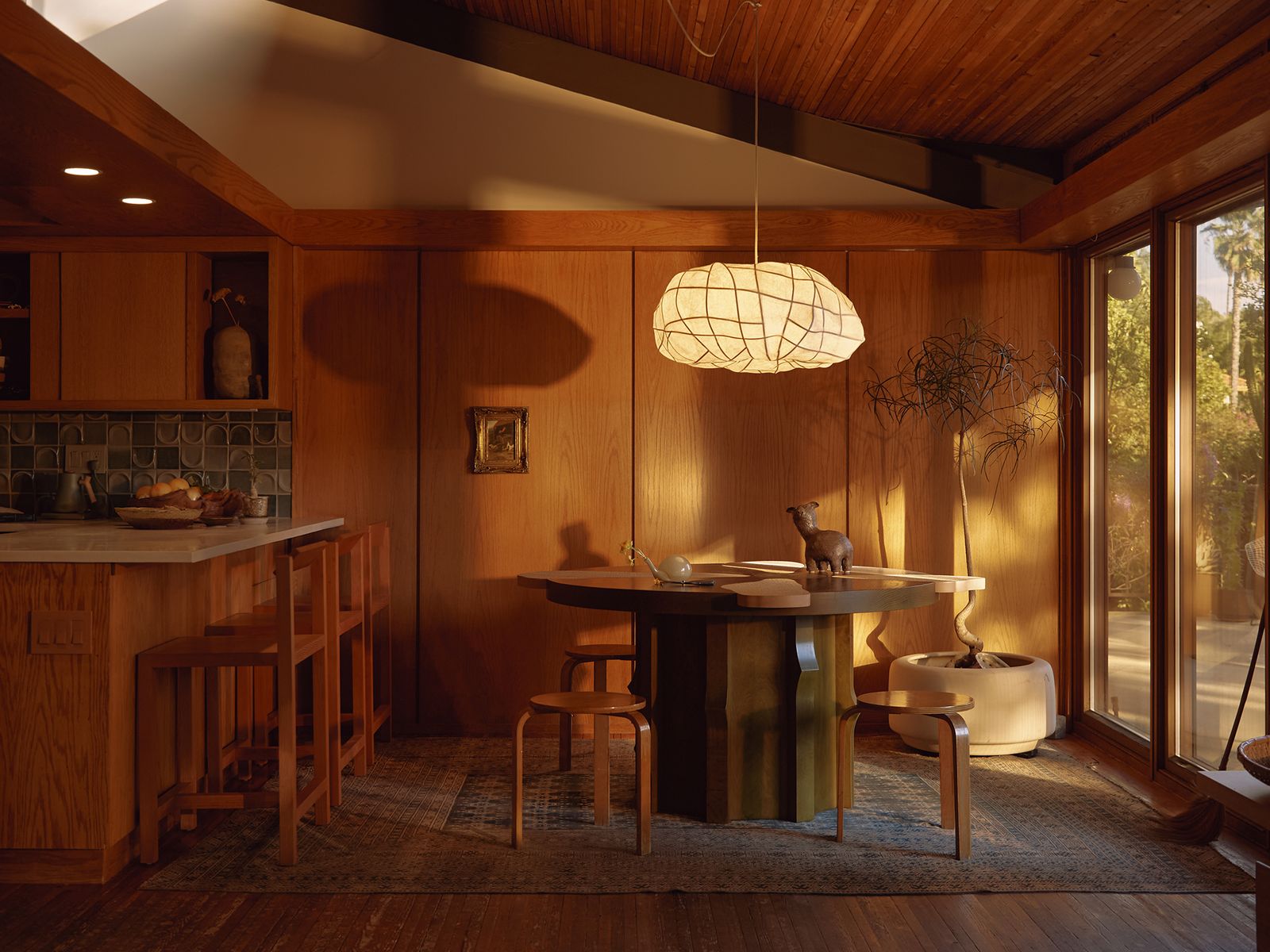
As it does for many, the idea of taking on a time capsule by a renowned midcentury architect gave Nick Pourfard pause. But where others might balk over the idea of how to sensitively restore one while still getting their dream kitchen, the designer and maker’s hangups with a Walter S. White–designed residence he was looking to buy in his hometown of Escondido were more over what, if anything, his own work could add to its iconic feel.
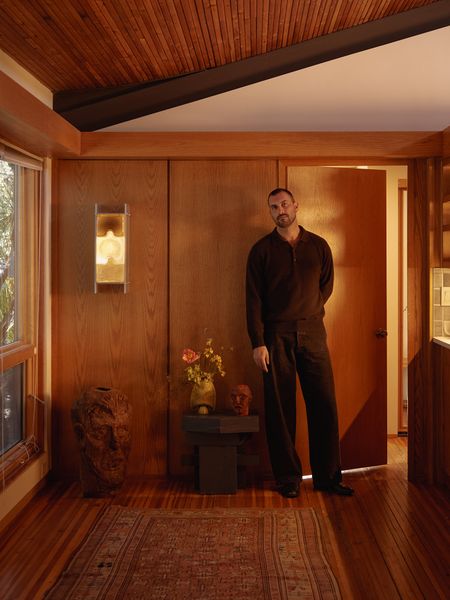
Designer and maker Nick Pourfard is constantly experimenting with his 1988 Walter S. White home in Escondido, as with a prototype for a glass sconce hanging in the entry. The sculpture in the corner is by Ben Day Todd, and the end table is by Steven Hartzog.
Photo by Connor Rankin
The Newton Stafford House II, built in 1988, had everything going for it. There was a butterfly roof—"one of White’s calling cards," says Nick—and a metal frame with a distinctive two-by-six lumber construction style that allowed for vaulted, open living spaces, with a wall of glass running along them. But it also had a perfectly neglected rear acreage where Nick could get up to any number of experiments, whether earth casting garden sculptures, planting cactus or fruit trees, or keeping bees. "I was pretty keen on having exactly what my dad set up for us as kids," he says, namely some land in a rural area near where he grew up that he could mold to his vision.
Now seven years since leaving his adopted homes of San Francisco and Brooklyn, and after having made a name for himself building guitars from old skateboards with his brand, Prisma, Nick has figured out what a working relationship with the White residence can look like. It shouldn’t be a sealed off relic, he says, but instead, a living, breathing monument to ephemerality. We spoke with Nick to hear about his ongoing interventions—including, yes, a kitchen refresh—how the home inspires what he decides to design and build next, and his resolution to make meaningful marks on the property that satisfy his many whims, support his design community, and cement his own legacy of constant evolution.
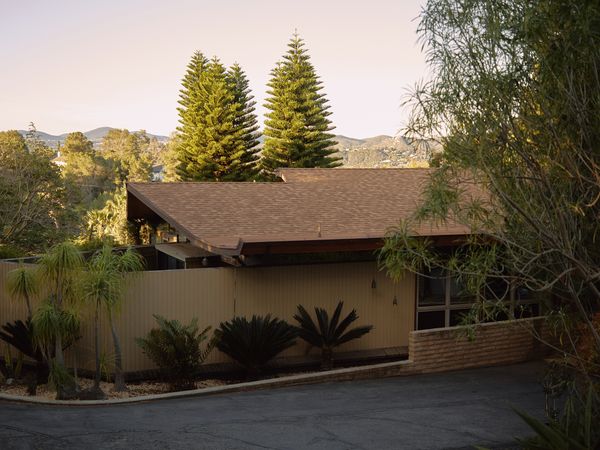
Nick loves the home’s swooping butterfly roof, an element of several of Walter S. White’s homes.
Photo by Connor Rankin
I’d love to know what you saw in the home. What attracted you to it? Why did you decide to buy it?
Nick Pourfard: I had lived in San Francisco, and New York for a while, but I knew I wanted to move back to Escondido, in San Diego. I grew up in a really rural area, on a dirt road in the middle of strawberry fields, kind of attached to a horse ranch, kind of attached to a nursery, and I just grew up being outside, you know? I have only good memories of childhood. So I wanted the same thing as what my dad had made for us. A lot of houses in Escondido come with land and your neighbors are farther away. I could do the types of things I wanted to do and have something that could be a lifetime project, something to grow into, something that I could bring my identity to.
This home had the land and everything I was looking for. But it’s also an architectural house, designed by Walter S. White, who did the Wave House in Palm Springs. It just blew me away. It had a butterfly roof—it looked so Japanese and so cool. There were also these crazy engineering things, like two-by-sixes for the roof slammed together. But I was torn because as a designer moving into a house that’s already so designed, that has so many characteristics that are iconic to midcentury architecture, I was a little nervous to coexist with that, you know? How could my pieces look in a space that’s already so iconic looking?
But then I sort of started to feel like it could work. I had to let go of the idea of restoration via White’s identity and kind of combine it with restoration via my identity, while considering him. I was like, what could I do that feels like me that still contributes to this era?
What are a few examples of how you brought your own identity to the home?
It was almost like the budget dropped when they did certain rooms, like the kitchen. The house has incredible windows and crazy millwork, and then when you look at the kitchen, it was like, okay, it’s just formica, and the basic white cabinet setup was really really weird and didn’t match. It had pretty basic red tiles that kind of worked. Everything just felt economical. But it didn’t make sense, either. I’m six two, the vent hood covers the burners, and I can’t even see while I’m cooking. So I just started ripping stuff out and rebuilding, but tried to mimic wood paneling that was here and color matched everything. I also rebuilt some of the soffit beams. People walk in and they think it’s always been like that. And I was like, no, you don’t even know.
The tile for the backsplash is new, too, right?
Yeah, so the tile was a challenge with a house that’s all wood. The wood is so comforting, but you need something to pull you out of that. I made friends with a company called Lofa, they’re in Guadalajara, and they push tile-making to a crazy level where there’s three dimensional stuff and really cool irregular glazes, like with broken glass bottles, or lava rocks melted down, or cutting slits in the clay and shoving pebbles into them so when they’re fired the spread open. I just wanted to support a company like that, you know?
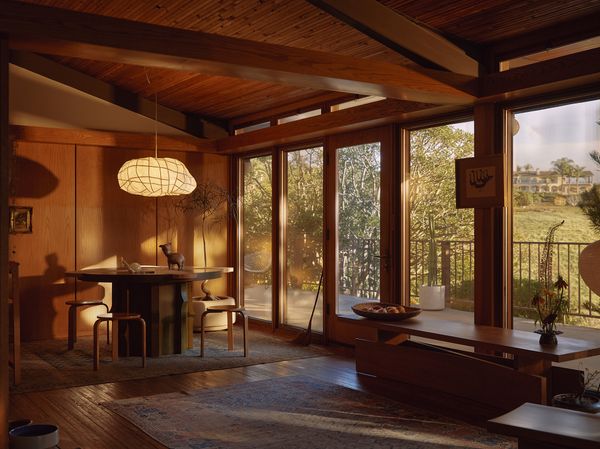
The Spring table in the dining area, which Nick designed after a cactus on his property, is surrounded by a set of vintage Stool 60s by Alvar Aalto.
Photo by Connor Rankin
See the full story on Dwell.com: My House: Designer and Maker Nick Pourfard’s San Diego Home Might Never Be Finished
Related stories:

No comments:
Post a Comment