
Everyone’s been thinking it. Now, legacy brands and emerging designers alike are talking about how to keep the region a part of the conversation.
This story is part of Fair Take, our reporting on global design events that looks up close at the newest ideas in fixtures, furnishings, and more.
At a dinner in Stockholm earlier this month celebrating the late Danish designer Verner Panton’s 100th birthday, Erik Rimmer, editor of Bo Bedre, the unofficial bible of Nordic design, put questions to a panel of design-world honchos to get a pulse check on the future of the region’s long-standing dominance over our homes. The room shimmered tip-to-toe in chrome, including Panton’s Panthella lamps and Pantonova seating, runners lining banquette tables, and a cascading backdrop for the panel. Rimmer had a mischievous twinkle in his eye as he baited a big hook. "I’ve covered a lot of Scandinavian design in my career," he said, "and I must say, it can be quite boring." What did they think about that, he wanted to know.
Nobody swallowed the barb, but there was nibbling. Phillipp Materna, the design lead for Ferm Living, a high-output Danish brand that makes blob mirrors and bouclé lounges for millennials matriculating from Ikea, said he "wasn’t going to go there." (If we did need a new perspective, though, he suggested we might look to distant shores; Materna himself is from Canada.) Louis Poulsen’s chief design officer, Monique Faber, gave Rimmer’s prompt the side eye, too—was she really going to say the modernist goliath she helms is snoozy? Nobody on the panel of four was ready to agree with Rimmer—fair enough. But collectively, there was an admission that yes, there might be room for some fresh thinking.
The squeamish moment during Stockholm’s design week embodied what has now become a long-simmering anxiety for Scandinavian design: that it might finally be losing its luster. Its aesthetics and now-clichéd descriptors—sleek, minimalist, clean-lined, natural, hygge, timeless—surged through the late 2010s. (In the last few years of the decade, Dwell ran no fewer than 50 headlines using the word "Scandinavian" to describe a home—since 2020, there have been far fewer than that.) Several of the influencers, critics, and designers Dwell spoke with at the beginning of the year said they were done with minimalism (to many, shorthand for the Scandi aesthetic) and ready for richness and complexity, or at least to step away from the idea that subtlety is the only path toward serenity—or that paring things down is an end in itself.
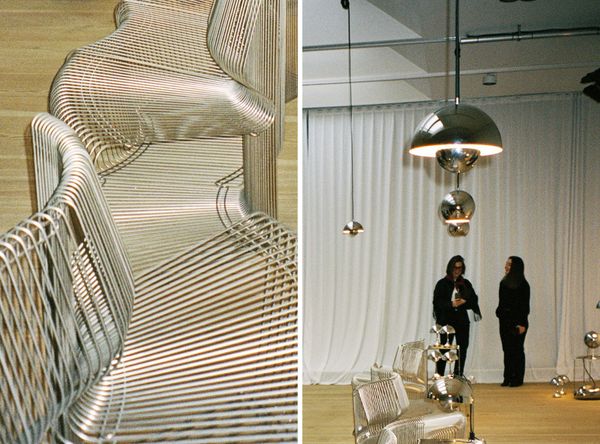
An exhibit during Stockholm design week curated by furniture shop Nordic Nest celebrated the late Danish designer Verner Panton’s 100th birthday, showing his Pantonova modular seating and Flowerpot pendants, and Poul Henningsen’s PH lamps, all in chrome.
Photo by Duncan Nielsen
Pockets beyond the Nordics reflect a desire for something punchier, too. From Puerto Rico, Estudio PM won a design contest last year at ICFF, North America’s biggest furniture fair, for tables and stools made from reclaimed textiles, one of which draws inspiration from horned masks worn during festivals on the island to ward off evil. The pieces are essentially collages celebrating ephemerality, "intended to change over time as an exploration of form and narrative." Some of the most memorable pieces from 3 Days of Design in Copenhagen last year came from Belgium. Valerie Objects, based in Antwerp, debuted Klasky-Csupo–colored lighting by design duo Muller Van Severn based on a lamp shade they unearthed from a flea market—the results might feel precious, but the input isn’t. At We Design Beirut in Lebanon, which ran its second edition in 2025, if designers put anything on a pedestal, it was only to knock them off of it. In one moment that can really only be described as performance craft, Dwell’s managing editor Jack Balderrama Morley looked on as a ceramics artist shattered pieces on the ground only to work them into new pieces on the fly. "It was a simple but effective metaphor for the continual reconstruction that Lebanese designers must take on," he says. More important than the act of preservation, or sealing an object in time as to crystallize it into some kind of gesamtkunstwerk, is the practice itself of destruction in the name of perpetual renewal.
Those holding the keys to the masterworks of the Nordics, including Faber at Louis Poulsen, do not enjoy this kind of liberty. (Although it is exhilarating to imagine Carl Hansen & Søn sledgehammering a Wishbone chair and puzzling it into some kind of new seating and the horror devotees of the Danish designer might suffer.) In Stockholm, it was apparent that heritage brands were grappling with how, exactly, they might evolve. Often, a brand’s biggest obstacle is its own legacy, and the farther back it reaches, it seems, the more difficult to stray from its core offering: In celebration of its 300th anniversary, Rörstrand, the Swedish tableware brand, only now released a colorway that marks a meaningful departure from its usual greens and blues, a caramel tone called Jubilee. (For tea cup sets gifted to press, including this writer, it was the classic blue.)
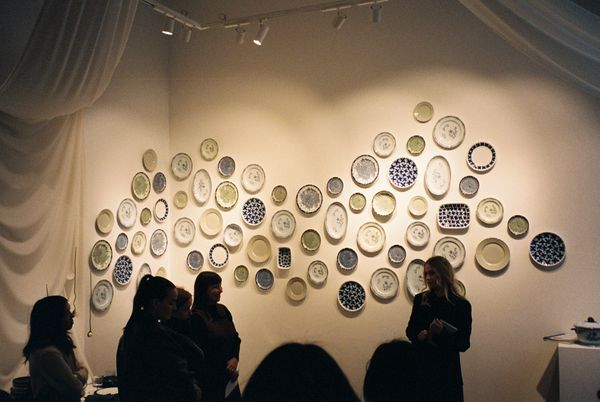
Rörstrand is the second oldest homewares brand still in existence in Europe, after German company Meissen. Founded in 1726, the company showed pieces in its classic delft-inspired blue, a newish green colorway, and a 300th anniversary collection in a caramel hue.
Photo by Duncan Nielsen
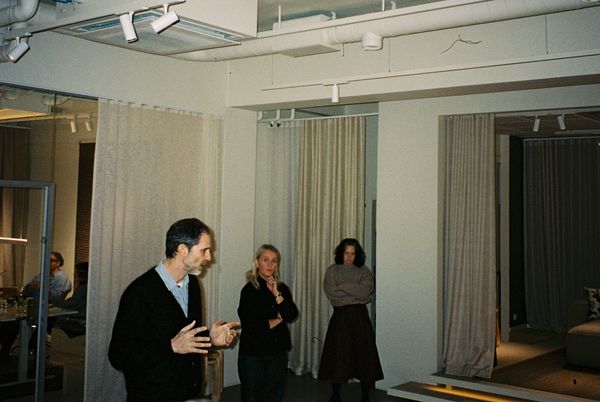
Swedish rug maker Kasthall, founded in 1889, partnered with London design studio Barber Osgerby to bring a fresh perspective to the brand, says the company’s CEO, Mirkku Kullberg. The new collection will debut in Milan this year. In Stockholm, Edward Barber explained how he iterated in real time with weavers in Sweden to determine new colorways.
Photo by Duncan Nielsen
See the full story on Dwell.com: When Did Scandinavian Design Get So Boring?

No comments:
Post a Comment